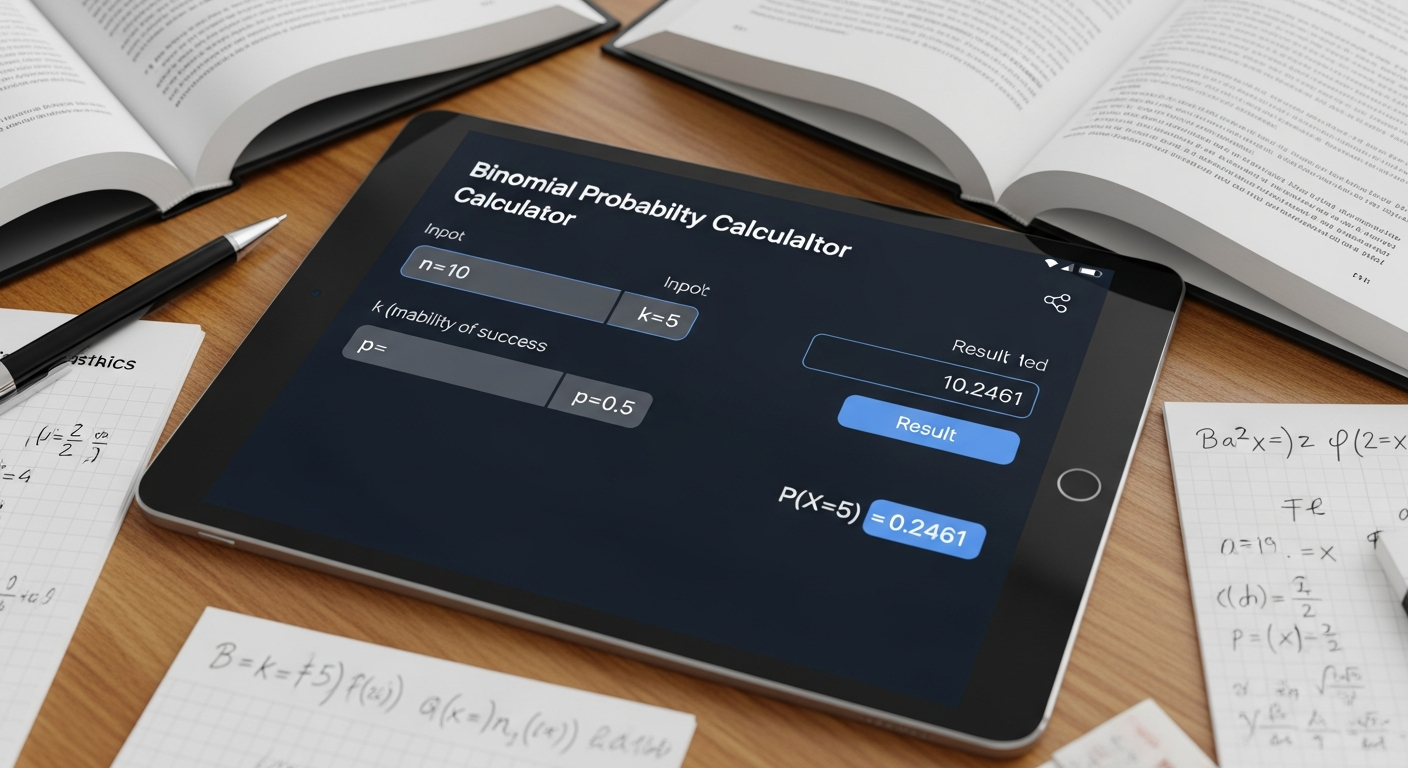
Understanding Binomial Probability Calculator is essential in fields like mathematics, statistics, data science, and even business analytics. However, when it comes to calculating the probability of success over multiple trials, things can quickly get complicated. That’s where a binomial probability calculator becomes incredibly useful. This guide explains everything about how it works, why it matters, and how you can use it to make data-driven decisions with ease.
What Is a Binomial Probability Calculator?
A binomial probability calculator is a powerful tool designed to compute the likelihood of a specific number of successes in a fixed number of independent trials. Each trial has two possible outcomes — success or failure. By entering values such as the number of trials, probability of success, and desired outcomes, the calculator provides an exact probability value.
In simple terms, it helps users quickly find the probability of achieving a certain result without manually performing lengthy calculations. This saves time, improves accuracy, and enhances decision-making in various applications.
How Does the Binomial Probability Calculator Work?
To understand how this calculator functions, let’s break it down. The binomial probability formula is:
P(X = k) = (nCk) × (p^k) × (1-p)^(n-k)
Here:
- n = total number of trials
- k = number of successful outcomes
- p = probability of success on each trial
- nCk = number of combinations (n choose k)
By entering these values, the calculator applies this formula automatically. It multiplies the combination factor by the probabilities of success and failure, giving you the final probability of your desired outcome.
Why Use a Binomial Probability Calculator?
Using this tool provides several advantages. First, it eliminates calculation errors that often occur in manual computations. Second, it helps visualize probability outcomes easily. Additionally, it allows users to experiment with different values to see how changing the probability of success or the number of trials affects the results.
Because of its speed and accuracy, this calculator is widely used by students, teachers, researchers, and analysts across disciplines.
When Should You Use the Binomial Probability Calculator?
You should use a binomial probability calculator when you’re analyzing situations that meet specific conditions:
- Each trial has only two outcomes — success or failure.
- The probability of success remains constant.
- Each trial is independent of the others.
Examples include determining the probability of flipping heads on a coin multiple times, predicting the number of customers who make a purchase, or estimating the success rate of a marketing campaign.
Key Features of a Binomial Probability Calculator
Modern calculators include several features that make them user-friendly and effective. They typically allow input for multiple trials, real-time calculation results, and graphical representation of probabilities. Some even show cumulative probabilities to help understand the chance of achieving at least or at most a certain number of successes.
With these features, users gain better insights into probability distributions and can make confident, data-backed predictions.
Benefits of Using a Binomial Probability Calculator
The calculator not only saves time but also boosts accuracy. It helps users perform complex statistical calculations in seconds, improving productivity and reducing human error. Moreover, it enhances learning by making mathematical concepts easier to grasp through visualization and instant feedback.
Because it’s often available online and for free, anyone can access it instantly, regardless of their math background.
Common Applications of Binomial Probability Calculators
A binomial probability calculator plays a vital role in many fields. In business, it helps forecast sales success rates. In medicine, it predicts treatment outcomes. In manufacturing, it estimates defect rates. Even in education, teachers use it to demonstrate probability concepts interactively.
As industries increasingly rely on data-driven insights, such calculators continue to gain importance across various professional domains.
Step-by-Step: How to Use a Binomial Probability Calculator
Using this calculator is simple. Here’s how you can do it:
- Enter the number of trials (n): Total events you’re analyzing.
- Input probability of success (p): The likelihood of success per trial.
- Set desired outcomes (k): How many successes you want to find the probability for.
- Click “Calculate”: Instantly get your result.
Some tools also provide cumulative probabilities and graphs for deeper analysis.
Understanding Results from a Binomial Probability Calculator
After calculation, the tool gives a decimal or percentage value. This represents the probability of the specific number of successes occurring in the given trials. For example, if the result is 0.25, it means there’s a 25% chance of achieving that outcome.
Interpreting results properly helps in making informed decisions, especially when evaluating risks or performance probabilities.
Limitations of Binomial Probability Calculators
Despite their advantages, these calculators have certain limitations. They only apply to binomial scenarios — cases with two possible outcomes. They may not suit situations with variable probabilities or dependent events. Additionally, while they give precise results, users must still understand the theory behind them for meaningful interpretation.
Recognizing these limits ensures more accurate use in real-world applications.
Tips for Getting Accurate Results
To obtain reliable results, always double-check input values. Make sure the probability of success is entered correctly as a decimal. Keep in mind that each trial should be independent, and the probability must remain constant. Adjusting the calculator settings properly helps generate trustworthy results every time.
Practicing with real-world examples strengthens your understanding of how probabilities behave under different conditions.
Advanced Features in Modern Binomial Probability Calculators
Some advanced versions now include AI-powered prediction models that automatically detect possible trends in data. These calculators use adaptive algorithms to refine calculations and suggest potential outcomes. Many even integrate with statistical software or learning platforms, offering a seamless experience for researchers and students alike.
As AI continues to evolve, these calculators are becoming more intelligent and interactive.
Conclusion:
A binomial probability calculator transforms how we handle probability problems. It simplifies complex equations, enhances learning, and supports smarter decision-making in both academic and professional settings. By using this tool, you can easily compute, visualize, and understand probabilities with precision.
If you’re ready to boost your analytical power, start using a binomial probability calculator today — and experience how effortlessly you can master probability!
FAQs
1. What is a binomial probability calculator used for?
It’s used to calculate the probability of achieving a specific number of successes in a fixed number of independent trials.
2. Can I use it for more than two outcomes?
No, it only applies to experiments with two possible outcomes — success or failure.
3. Is a binomial probability calculator suitable for students?
Yes, it’s perfect for students learning probability concepts and practicing problem-solving.
4. How accurate are the results?
Results are mathematically precise if correct inputs are provided, ensuring high reliability.
5. Do I need advanced math skills to use it?
Not at all. The calculator is beginner-friendly and designed for quick, accurate use without complex math knowledge.